Service Dog Tasks and the Public Access Test, Explained
This page explains the law in general terms. It is not legal advice. For a specific situation, contact the agency listed on this site or an attorney.
Two questions come up again and again when people start training a service dog in Illinois. What tasks can a service dog do? And what is the public access test, and does the dog have to pass it?
This guide answers both in plain English. It walks you through choosing a task, teaching it with reward-based methods, and then using a public access test as a way to check your dog's manners in public. It is general information about the law, not legal advice.
The short version
- ADA.gov defines a service animal as a dog individually trained to do work or perform tasks for a person with a disability.
- The task has to be tied to the disability. Comfort alone is not a task.
- The public access test is a training benchmark. It is not a legal requirement under the ADA, and there is no official test, registry or certificate that proves a dog is a service dog.
- Illinois adds its own rules. Read our guide to service dogs in Illinois, including training, access rights and where to go for help for the state picture.
What counts as a task under the ADA
The ADA.gov Service Animals FAQ describes a service animal as a dog that is individually trained to do work or perform tasks for a person with a disability. Two words matter here: individually trained and work or tasks.
The work or task must be directly related to the person's disability. A dog that does something the handler could not easily do alone, or that notices and responds to something connected to the condition, is doing a task. A dog that is simply pleasant to have around is not.
Examples of tasks by type of disability
Illinois law, as summarized by the Animal Legal & Historical Center, lists service animals trained for hearing, guide, assistance, seizure alert, mobility, psychiatric, autism or other disability work. The examples below are illustrations of the kind of trained behavior that fits each area. They are not a complete or official list, and every team's tasks depend on the handler's needs.
| Area of disability | Examples of trained tasks |
|---|---|
| Hearing | Alerting the handler to a doorbell, a smoke alarm or their name being called by touching them in a set way |
| Vision (guide work) | Guiding around obstacles, stopping at curbs and stairs |
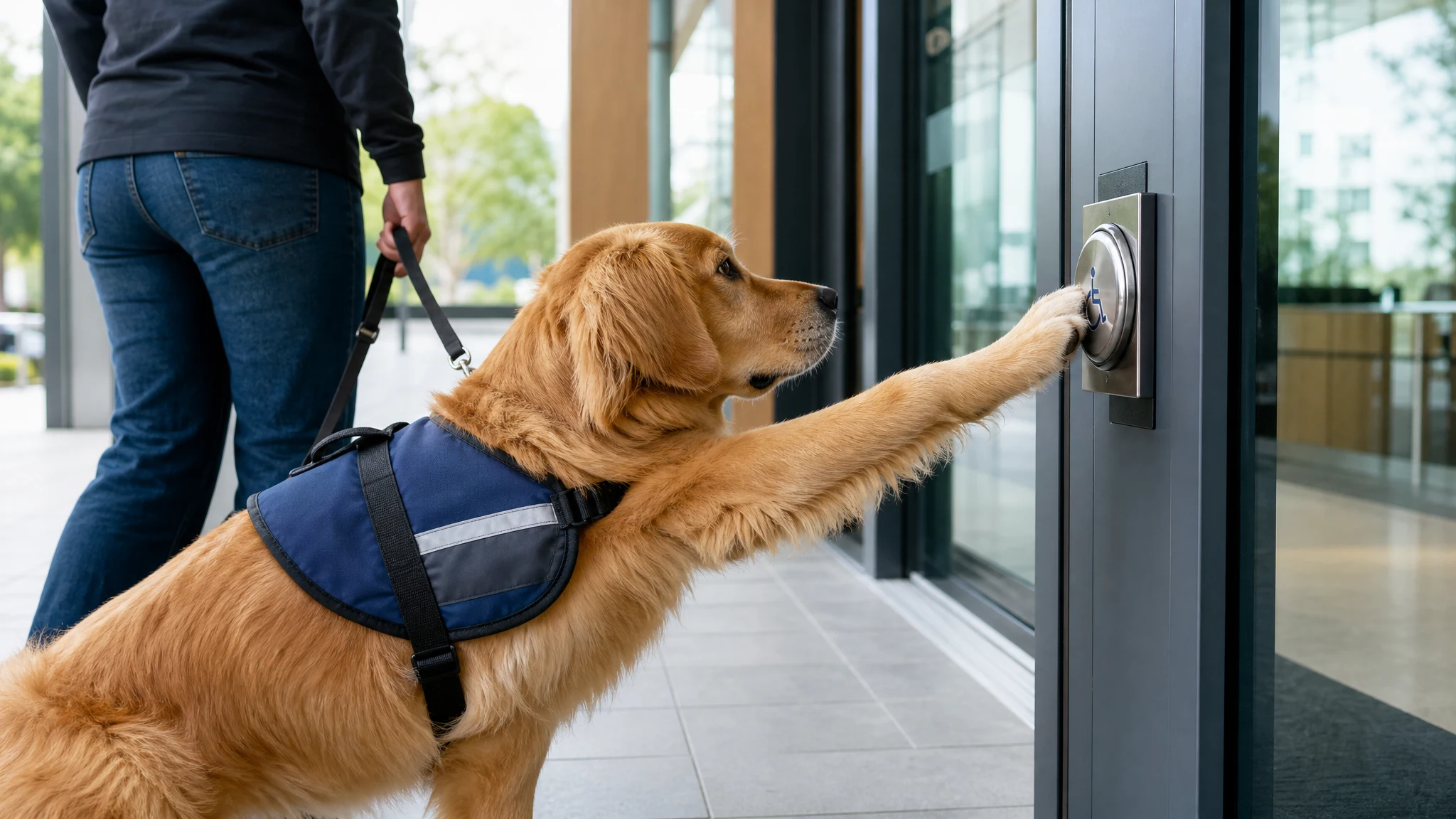
| Mobility | Retrieving dropped items, opening and closing doors, bracing for balance, pulling a wheelchair |
| Seizure | Staying with the handler during a seizure, fetching help or a phone, or alerting to a seizure if the dog has been trained to do so |
| Psychiatric, including PTSD | Interrupting a behavior pattern, turning on lights and checking a room, creating space in a crowd on cue |
| Autism | Interrupting repetitive behavior, keeping a person from wandering, providing a steady anchor on cue |
Not every program trains every kind of dog. For example, Paws Giving Independence in Peoria says on its site that it does not train psychiatric or diabetic alert dogs. If you are looking for a program, ask each one what it trains.
Why comfort alone is not a task
This is where people most often get tripped up. Under the ADA, emotional support, therapy and comfort animals are not service animals. A dog whose only role is to calm someone by being present is not doing a trained task, even though that calm may matter a great deal to the person.
Compare two situations. A dog that simply sits near a person with anxiety and offers companionship is providing comfort. A dog that has been taught to recognize the start of a panic episode and then performs a specific, trained response, such as applying pressure on cue or interrupting the behavior, is performing a task.
The line is about training and function, not about how much the person loves the dog or how much it helps emotionally. If you are unsure which side your situation falls on, the ADA.gov FAQ is the place to check the federal definition.
What you need before you start
- A clear need. Write down which parts of the disability a trained task could help with. This keeps training focused.
- Small, soft training treats. Pea-sized pieces your dog loves, so you can reward many times in a session.
- A flat buckle collar or a front-clip harness and a standard leash. Choose gear that does not cause pain. Do not use shock, prong or choke collars.
- A clicker or a marker word such as "yes," if you like marking the exact moment of success.
- A notebook or phone notes to log each session, so you can see progress and problems.
- A quiet place to start, then a plan for gradually harder places.
- Time. Task training and public manners build up over months, not days.
Step by step: teaching a task and checking public manners
Step 1: Define the task in one sentence
Write the task as a cue and a response. For example: "When I say 'get it,' my dog picks up the dropped item and puts it in my hand." If you cannot say it in one sentence, break it into smaller pieces.
Step 2: Teach the foundation behaviors first
Most tasks are built from simple pieces: sit, down, touch, hold, come and settle. Teach each with food rewards and short sessions of a few minutes. Reward the behavior you want, and quietly reset when the dog gets it wrong. This is the approach in line with the American Veterinary Society of Animal Behavior (AVSAB), which supports reward-based training.
Step 3: Shape the task in small steps
Break the task into stages and reward each. To teach a retrieve, you might first reward looking at the item, then touching it with the nose, then mouthing it, then picking it up, then bringing it to you. Raise the bar only when the dog succeeds several times in a row.
Step 4: Add the cue
Once the dog reliably does the behavior, say the cue just before it happens. Keep the cue the same every time. If the task is an alert rather than a cued behavior, work with an experienced, reward-based trainer or program, since alert behaviors are hard to build well on your own.
Step 5: Practice in new places and with distractions
A task that works in your living room may fall apart in a store. Move gradually: the yard, a quiet street, a pet-friendly store entrance, then busier places. Make each change small, and go back a step if the dog struggles.
Step 6: Build calm public manners
A working dog needs to stay calm around food, strangers, noise and other animals. Practice settling under a table, ignoring dropped food, walking on a loose leash and staying unbothered when someone approaches. Reward calm behavior often.
Step 7: Use a public access test as a checkup
A public access test is a structured list of skills that shows how your dog behaves in public. Assistance Dogs International (ADI) is the group most often associated with this kind of standard. Programs use it to decide whether a dog is ready to go out in public as a working partner.
Treat it as a practice exam for you and your dog. Typical areas include:
- Walking calmly on a loose leash through a busy space
- Staying settled while you sit or eat
- Not reacting to other dogs, noise or food on the floor
- Coming when called and holding a sit or down despite distractions
- Staying focused on the handler
- Staying clean and well-behaved in indoor spaces
The exact items and scoring vary by program. If you want the real standard, ask ADI or the accredited program you are working with for its current version rather than relying on a copy from a website.
Step 8: Repeat and keep notes
Run your own mock test every few weeks in different places. Note what went well and what slipped, and train the weak spots. Dogs are not machines, and an off day does not mean the training has failed.
The public access test is not a legal requirement
This point causes a lot of confusion, so it is worth saying clearly. Under the ADA, there is no official service dog registry and no required certification. There is no government-run public access test that a dog must pass to be covered.
The test is a training tool. It helps you judge whether your dog is ready for public work. It does not create or remove legal rights.
Online registrations, ID cards and certificates are not legal proof of anything under the ADA. You do not need to buy one, and we do not recommend it.
What ADA.gov says staff may ask when it is not obvious that a dog is a service animal comes down to two questions:
- Is the dog a service animal required because of a disability?
- What work or task has the dog been trained to perform?
Those questions are described on the ADA.gov page on revised ADA requirements for service animals. This is why being able to name the dog's tasks matters so much. It is the heart of the definition.
What Illinois adds
Illinois has its own laws on top of the ADA. According to the Animal Legal & Historical Center's consolidated page, 720 ILCS 5/48-8 defines a service animal as a dog or miniature horse trained or being trained for hearing, guide, assistance, seizure alert, mobility, psychiatric, autism or other disability work. That is broader than the ADA, which covers dogs only. The same source says the section covers animals being trained.
The Illinois Department of Human Rights says the Illinois Human Rights Act covers public accommodations, and it lists allowing service animals where required by law as a reasonable accommodation. Excluding service animals is given as an example of a discriminatory policy.
The exact wording of the access statute, the conditions for trainers, and Illinois rules on housing, employment and misrepresentation should be confirmed with the agencies below. Our Illinois service dog law guide pulls the state pieces together.
Tips for better results
- Keep sessions short. Five minutes, a few times a day, usually beats one long session.
- End on a win. Finish with something your dog does well.
- Reward the calm moments. Pay your dog for lying quietly, not only for working.
- Train the handler too. Your timing, body language and consistency shape the result.
- Watch your dog's stress. Yawning, lip licking, a tucked tail or refusing food can mean the setting is too hard. Back up.
- Work with a reward-based trainer if you hit a wall, especially for alert tasks.
- Know when to ask for help. Illinois programs such as Got Your Six Support Dogs in Maryville, Paws Giving Independence in Peoria, MidAmerica Service Dogs' Foundation (mailing address in Lemont) and K9s for Veterans NFP in Plainfield describe their own services on their sites. Contact them directly for current eligibility and waitlists, since those details are not published in one place.
Common mistakes to avoid
- Treating comfort as a task. If the dog's only job is to be there, it is not a service dog under the ADA.
- Buying a registry, vest or certificate to "prove" status. None of these is legal proof, and none is required.
- Skipping the foundations. A task built on shaky basic skills tends to break under pressure.
- Rushing into public places. Go gradually. A dog that is overwhelmed learns the wrong lessons.
- Using punishment. Shock, prong and choke collars, alpha rolls, scruffing and dominance methods are not part of humane training, and they can damage the trust a working team depends on.
- Treating the public access test as pass or fail for your rights. It measures readiness. It does not decide legal coverage.
- Letting a nervous or reactive dog work anyway. A dog that cannot stay calm in public is not ready, and pushing it can hurt both of you.
What to expect
With steady, reward-based practice, many teams find that a dog can learn a reliable task over several months, and that public manners often improve as the dog gains experience. Timelines vary a lot by dog, task and handler, and some dogs turn out not to suit public work. That is not a failure. Results depend on the individual dog, and no training plan can promise a particular outcome.
A realistic goal is a dog that performs its trained tasks on cue, stays calm in the places you go, and handles a mock public access test without major problems. If your dog struggles, a program or a reward-based trainer can help you work out whether to keep going or change course.
If a business turns you away
If you are denied access in Illinois, you can contact the Illinois Department of Human Rights (IDHR) through its charge process page. The Illinois Attorney General's Disability Rights Bureau is another option, with offices in Chicago at 312-814-5684 and Springfield at 217-524-2660. Rules on penalties, deadlines and housing differ, so check with the agency directly.
For veterans, the Illinois Department of Veterans' Affairs explains VA service and guide dog eligibility on its Service Animals page. It says the VA does not provide dogs but offers veterinary care and support, and that dogs must come from an ADI or IGDF accredited organization.
Sources
- ADA.gov, Service Animals FAQ
- ADA.gov, Revised ADA Requirements: Service Animals
- Animal Legal & Historical Center, Illinois Assistance Animal and Guide Dog Laws
- Illinois Department of Human Rights, Public Accommodation Rights
- Illinois Department of Human Rights, Charge Process
- Illinois Attorney General, Disability Rights
- Illinois Department of Veterans' Affairs, Service Animals